
A single limb lengthening surgery realistically adds 6 to 8 cm (about 2.4 to 3.1 inches) when done on the femur, and 5 to 7 cm (2.0 to 2.8 inches) when done on the tibia. Patients who stack two operations 12 to 18 months apart can reach 13 to 16 cm, which is roughly 5 to 6 inches. Anything beyond that is either a two-stage plan being sold as one, or a quiet acceptance of high complication risk.
What is the realistic single-surgery maximum?
For one operation on one bone segment, 6 to 8 cm is the upper end most reputable surgeons will quote. Beyond 8 cm, nerve traction, joint stiffness, and soft-tissue strain rise sharply.
PRECICE 2 femur lengthening typically targets 5 to 8 cm, with 6 cm as the safe sweet spot most surgeons aim for. Dr. Dror Paley at the Paley Institute in Florida and Dr. Shahab Mahboubian in California both publish 6 cm as their default cosmetic femur target. PRECICE 2 tibia lengthening runs lower — 4 to 7 cm typical, 5 to 6 cm safe sweet spot. The tibia has less soft-tissue envelope and less nerve slack to give.
LON, the hybrid method popular in Turkey, often pushes a bit further. Some Turkish surgeons routinely take 7 to 8 cm in the femur because the external rail offers stronger fixation during distraction. The trade-off is higher pin-site complication risk and a longer fixator-on phase.
Ilizarov can reach 6 to 10 cm in the femur and 6 to 8 cm in the tibia. It is the highest single-stage ceiling, paid for in months on a frame.
What can two stages add?
If you do the femur first and the tibia 12 to 18 months later, the total gain stacks. Femur 6 to 8 cm plus tibia 5 to 7 cm gives 11 to 15 cm. The most aggressive two-stage plans, done by surgeons comfortable at the upper end of each segment, can push 13 to 16 cm. That is around 5 to 6.3 inches.
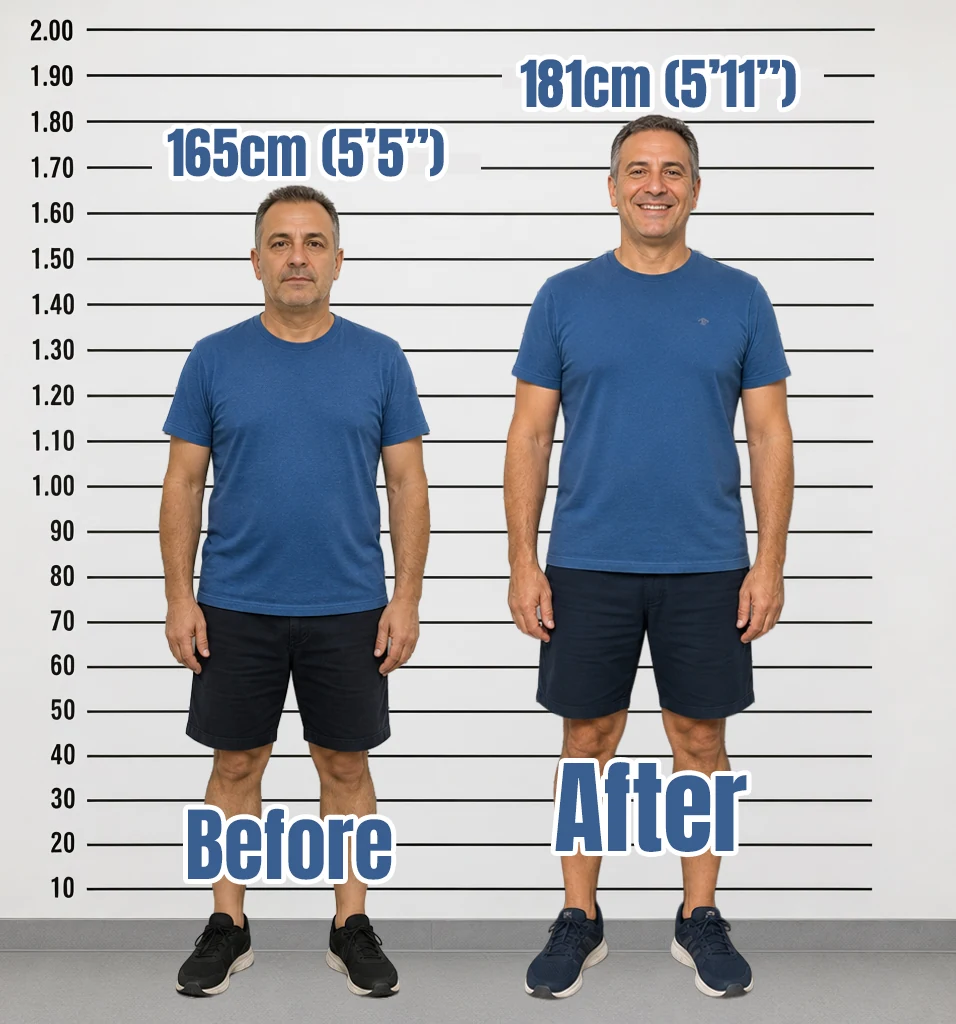
The homepage hero chart on this directory shows a 165 cm patient reaching 181 cm. That is 16 cm — the realistic upper bound of a fully completed two-stage cosmetic plan.
Two-stage is not just a multiplier. Stage 2 happens on a body that already adapted to stage 1. Some patients reach the end of femur recovery and decide the gain was enough. Others develop joint or proportion concerns that push them to skip stage 2. Surgeons report a 20 to 30 percent stage-2 dropout in cosmetic two-stage plans, though formal published data is thin.
Dr. Yuksel Yurttas in Istanbul has filmed long patient interviews including one documenting a three-procedure stack from 172 cm to 192 cm. Twenty centimeters total, across three operations, is the very upper extreme — and it took years.
Why "10 inches in one go" is a myth
Ten inches is 25.4 cm. No single bone segment, in any human anatomy, can safely tolerate that much distraction. Marketing claims of 10-inch single-procedure gains compress two surgeries into one description, conflate inches with centimeters, or quietly tolerate complication rates that responsible surgeons will not accept.
The physiological limit is set by nerve elasticity. Peripheral nerves stretch about one percent per day before showing electrophysiological strain. The standard distraction rate of 1 mm per day keeps nerves inside that envelope. Push faster or longer and you get foot drop, persistent numbness, or chronic neuropathic pain. Push the absolute distance too far and you also outrun the blood supply to the regenerating bone.
Any clinic that advertises a single-procedure result above 8 cm without naming a specific surgeon, a specific method, and a peer-reviewed case series should be treated as a marketing claim, not a clinical one.
Gain ranges by method, side by side
The numbers below come from published case series and the directory's per-method profile pages. Single-stage means one bone segment, one operation. Two-stage means a femur followed by a tibia, separated by 12 to 18 months.
Notice that LON and Ilizarov produce larger single-stage gains than PRECICE 2. That advantage comes at higher complication and discomfort cost. The right number for you is the one your surgeon's published outcomes support, not the largest number a marketing page will quote.
| Method | Femur (single) | Tibia (single) | Two-stage total | Notes |
|---|---|---|---|---|
| PRECICE 2 | 5-8 cm | 4-7 cm | 10-15 cm | Safe sweet spot is 6 cm femur. |
| PRECICE Max | 5-8 cm | Not approved | N/A | Femur-only device, FDA-cleared for adults. |
| LON (hybrid) | 5-8 cm (often 7-8) | 5-7 cm | 11-15 cm | Higher Turkish single-stage targets; more pin-site risk. |
| Ilizarov | 6-10 cm | 6-8 cm | 13-18 cm | Highest ceiling, highest complication tolerance. |
What happens to your proportions
Lengthening only the legs shifts the torso-to-leg ratio. Most patients do not notice. Some do, especially after gains above 8 cm. The leg-to-torso ratio that reads as 'normal' to a viewer sits in a fairly wide window — the people you walk past on the street include adults whose legs are 47 to 55 percent of their standing height. A 6 cm gain typically shifts that ratio by 1 to 2 percentage points, which is inside the noise.
At 13 to 16 cm of total gain, the ratio shift becomes visible to a trained eye. The torso looks shorter relative to the legs. Whether that reads as 'long-legged' or 'disproportionate' is partly aesthetic and partly cultural. East Asian cosmetic LL trends often target a higher leg-ratio than European norms.
A careful surgeon evaluates current and projected ratio before quoting a target gain. Ask to see your projected silhouette overlaid on your current one. If the clinic does not offer this, it is a soft signal that they treat the surgery as a number, not a body-design decision.
What patients actually choose
Across the directory's clinic interviews and patient diaries, 6 cm femur is the most common single-stage target patients commit to. It fits inside almost every surgeon's safety envelope, produces a visible difference in everyday clothing, and keeps the recovery timeline at 9 to 12 months rather than the 14 to 18 months a more aggressive plan requires.
Patients targeting 8 cm or more on a single segment are usually starting from below 165 cm and aiming to reach a culturally specific threshold — 170 cm, 175 cm, 180 cm. The closer the target is to a round number above current height, the more likely the patient stretches the plan to its limit.
Dr. Mahboubian's patient interviews consistently surface the same trade-off: patients who took 6 cm describe the experience as recoverable. Patients who took 8 cm or more describe a harder, longer year. None of the patients filmed at the LimbplastX Institute, Wanna Be Taller, or LiveLifeTaller channels regret the gain itself — they describe regretting underestimating the recovery cost of pushing the gain.
Three questions to ask before fixing your number
Before committing to a target gain, the surgeon should be able to answer three questions specifically about your case, with imaging and measurements in hand.
First: what does my current leg-to-torso ratio look like, and what will it look like at the target gain? A drawn-on radiograph or a photogrammetry mock-up beats a verbal estimate.
Second: what is your published complication rate at the gain I am asking for? Surgeons who routinely take 6 cm have different rates from surgeons who routinely take 8 cm in the same method. Ask for the number at your target, not the average across all their cases.
Third: at what gain do you stop me? Every reputable surgeon has a ceiling beyond which they will refuse to operate. A surgeon who has no such ceiling, or who will not name it, is the wrong surgeon.
If you are considering a two-stage plan
Two-stage adds height but compresses 18 months of recovery into a 30-to-36-month window. The femur recovers first. The tibia recovers second on a body that is already adapted to the femur gain — which can be helpful (you know what to expect) or punishing (your reserves are lower).
The standard interval is 12 to 18 months between the two operations. Some surgeons will do tibia at 9 months if femur consolidation is fast and clean. Others insist on 18 to 24 months.
A realistic two-stage plan looks like: 6 cm femur, 12 to 15 months recovery to full impact, 5 cm tibia, another 10 to 12 months recovery. Total elapsed time from first surgery to fully recovered second surgery: 24 to 30 months. Total height gain: 10 to 12 cm.
The Paley Institute and HSS publish two-stage outcomes for reconstructive cases. Pure cosmetic two-stage outcome series are thinner. Ask your surgeon to show you specific two-stage case files, with timelines and complications listed, before you commit to the full plan rather than the first surgery.

- ·Realistic single-surgery gain is 6-8 cm in the femur, 5-7 cm in the tibia.
- ·Two-stage patients reach 13-16 cm total — 5 to 6 inches.
- ·Single-procedure gains above 8 cm push the limits of nerve elasticity and bone biology.
- ·Most cosmetic patients pick 6 cm femur as their target — it fits the safety envelope.
- ·Lengthening only the legs changes the torso-to-leg ratio; ask to see the projection before booking.
- ·A surgeon who will not name their refusal threshold is the wrong surgeon.
Quick answers
Is 10 cm of height gain possible from one surgery?+
Only with the Ilizarov method, and only in the femur, and at a complication cost most cosmetic patients would not accept. The realistic single-surgery ceiling is 8 cm with PRECICE 2 or LON.
How much taller can you get from femur and tibia combined?+
A complete two-stage cosmetic plan (femur first, tibia 12-18 months later) realistically adds 11 to 15 cm. The most aggressive plans reach 16 cm, which is the upper bound across two operations.
Why is the tibia limit lower than the femur limit?+
The tibia has less soft-tissue envelope around the bone and the peroneal nerve is more vulnerable to traction. Surgeons cap tibia gain around 5-7 cm to keep nerve injury rates acceptable.
Will my torso look short after lengthening?+
Not at a 6 cm single-stage gain. At a two-stage 13-16 cm gain, the leg-to-torso ratio shift becomes visible. Ask your surgeon for a projected silhouette mock-up before committing to a target.
How fast does the bone actually grow during lengthening?+
The standard distraction rate is 1 mm per day, usually divided into four 0.25 mm turns. That gives roughly 1 cm every 10 days. A 6 cm gain takes about 60 days of active distraction, followed by 3-6 months of consolidation.
Sources
- 1.O'Halloran et al., 'Stature seekers: Cosmetic limb lengthening in medical tourism', JPRAS Open, 2024 (PMC11415641) — Case report documenting a complicated two-stage cosmetic lengthening referred internationally.
- 2.Paley Institute — Stature Lengthening Center — Published gain targets and surgical philosophy.
- 3.Hospital for Special Surgery — Limb Lengthening Service — Academic reference center; published two-stage protocols.
- 4.Height Lengthening — Dr. Shahab Mahboubian — US West Coast cosmetic LL practice.
- 5.Wanna Be Taller — Dr. Yunus Öç — Turkish LON-focused practice publishing patient interviews with documented gains.
- 6.Prof. Dr. Yuksel Yurttas — patient interview library — Includes the 172 cm to 192 cm triple-stack interview.
- 7.FDA — PRECICE intramedullary lengthening system — Regulatory background for PRECICE 2 device class and indications.
- 8.AAOS — Limb Lengthening — Patient-facing reference on distraction osteogenesis.
Get matched with a verified clinic.
Our editor reviews your inquiry and introduces you to 2–3 clinics that fit your budget and goals. First clinic consult is usually free. We never sell your data.
Get matched — free →